
Summary:
- Fastener choice for James Hardie siding depends on the product and what you are fastening into, not on a single best screw.
- HardiePlank lap siding is typically blind nailed per manufacturer instructions, while screws come into play with steel framing and certain panel applications.
- Corrosion resistance matters more in Colorado than fastener type, since freeze-thaw cycling punishes any coating that fails.
- GS Exterior Experts installs James Hardie siding across the Denver metro to the manufacturer’s specification.
The best screw for Hardie board siding is often not a screw at all. James Hardie’s instructions vary by product and by what sits behind the siding; for standard lap siding on wood framing, the manufacturer specifies nails. Screws earn their place in specific situations, mainly steel framing and certain panel applications.
This distinction decides whether a warranty holds. GS Exterior Experts has installed James Hardie siding across the Denver metro since 1999, and we adhere to the manufacturer’s published specification on every elevation. Here is how the choices break down, and where homeowners most often get it wrong.
What kind of screws are used for Hardie board?
Fiber cement behaves differently from wood or vinyl under a fastener, and the wrong choice cracks the board or fails early. Our overview of what Hardie board is made of covers why the material is unforgiving here.
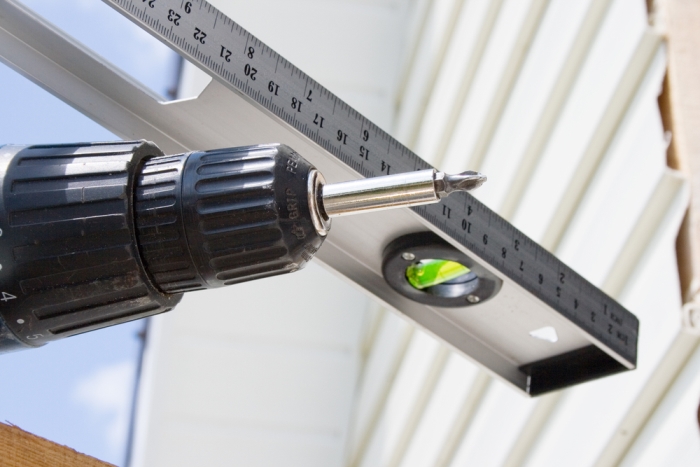
Where screws are specified, the ones that work have a sharp point and a wide, flat head. The sharp point helps the screw penetrate the material, and the wide head helps to distribute the load evenly. Screws for Hardie board siding should be at least 1 1/4 inches long to penetrate the board.
A few screw types will work for Hardie plank, and the trade-off is corrosion resistance against cost. For example, stainless steel screws are a good option because they won’t rust or corrode over time.
However, they can be more expensive than other types of screws. Another option is to use galvanized screws, which are less expensive but may not last as long as stainless steel. It is important to use screws made from corrosion-resistant materials, such as stainless steel or zinc-coated steel.
Corrosion resistance matters more in Colorado than almost anywhere, since freeze-thaw cycling finds every weak coating. It is one of several factors in how long Hardie board lasts on a Denver-area home.
What is the best fastener for Hardie board?
The answer depends on the product. For James Hardie siding in standard residential applications, the manufacturer’s instructions govern, and lap siding differs from panel products.
HardiePlank Lap siding has a more specific answer. James Hardie recommends installing this material using the blind nailing technique. This way, the fasteners are hidden.
Install fasteners between 3/4 in. and 1 in. from the top edge and no closer than 3/8 in. from the ends of the plank.
The blind nailing technique calls for siding nails or 6d common nails with wood framing. For steel framing, you can use screws for Hardie plank, notably the Ribbed Bugle-Head No. 8, 0.323 in. x 1.625 in. Be sure to use the right Hardie plank screws here so as not to crack the material.
How should Hardie board be fastened?
It depends on the product and the framing. Follow James Hardie’s published instructions for the specific product, which govern fastener type, placement, and penetration depth.
Where screws are specified, pre-drill pilot holes to avoid cracking the board, use a corrosion-resistant screw of at least 1 1/4 inches, and countersink only slightly. Set the fastener flush rather than driving it below the surface, since overdriving is one of the more common causes of premature failure. Fastening gets more particular at openings, where flashing, trim, and siding all meet. Our walkthrough of installing Hardie siding around windows covers those transitions.
Do you need to pre-drill Hardie board?
Skipping pilot holes increases the risk of stripping, breaking a fastener, or cracking the board, particularly near ends and edges where fiber cement is least forgiving. Pre-drill before driving screws.
Should You Fasten Hardie Board Yourself?
James Hardie warranties depend on installation in accordance with specifications, including fastener type, placement, and penetration depth. A fastener set a quarter inch off the mark will not fail on day one. It fails in year six, after the warranty conversation has already been decided.
If you are still choosing materials, our comparison of Hardie board versus vinyl siding covers the tradeoffs before fasteners enter the picture.
Hire a James Hardie Elite Preferred Contractor and Skip the Guesswork
Fastening is the part of a siding job nobody sees, and everybody pays for. Set too deep, too shallow, too close to an edge, or in the wrong material, and the failure shows up years later as cracked butt ends, weeping fastener heads, or a warranty claim that goes nowhere.
A James Hardie Elite Preferred Contractor removes that question from your plate. The designation means the crew works from James Hardie’s current installation guide rather than from habit, so fastener type, spacing, and edge distance are settled before anyone picks up a gun.
That standard carries across every product we install. Our siding installation services cover fiber cement, composite, and vinyl, and homeowners weighing the premium end usually start with the James Hardie Statement Collection.
Before hiring anyone, ask what certifications they hold and which fastener they will use for your specific product. A contractor who can answer both without checking has already thought about the details you are paying them to handle.
For the record, ours is James Hardie Elite Preferred, and the answer depends on your product and framing, which is the point of this article. GS Exterior Experts has installed James Hardie siding across the Denver metro since 1999. Contact GS Exterior Experts today to talk through your project.