
If you’re looking at Hardie board for your home, it’s worth knowing what’s actually in it, because the composition explains most of how it behaves.
The short version: cement, sand, and cellulose fiber. Here’s what each one does, what you get as a result, and where the material costs you something.
What is Hardie Board?
Hardie board, also known as Hardiplank siding, is a durable, long-lasting siding material that is popular among homeowners for its attractive appearance and excellent warranty. Hardieboard is manufactured by the James Hardie company.
What is Hardie Board Made Of?
Hardie board is Portland cement, sand, cellulose fiber, and water. The cement and sand give it density and make it non-combustible under ASTM E136. The cellulose fiber gives it flexibility, which is what stops a cement board that thin from being brittle.
Because it’s cement-based rather than wood-based, it doesn’t absorb water the way timber does, so freeze-thaw cycling has far less to work with. That’s the main reason it suits Colorado.
Benefits of Using Hardieboard Siding
Fiber cement is classified as non-combustible under ASTM E136, and termites have no interest in it. It handles heavy rain and wind well, and it stays dimensionally stable through temperature swings rather than expanding and contracting the way wood and vinyl do.
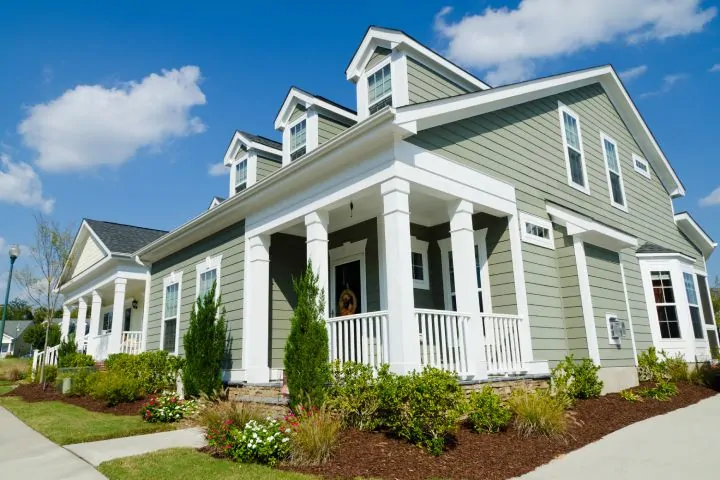
It comes in a wide range of profiles and textures, which is why it suits everything from a 1920s bungalow to a new build.
The warranty is the strongest part. James Hardie backs the substrate for 30 years, non-prorated, meaning the coverage doesn’t step down as the years pass. The ColorPlus® finish carries a separate 15-year warranty against peeling, chipping, and cracking.
Drawbacks of Hardieboard Siding
While Hardieboard siding is an excellent choice for many applications, it does have a few potential drawbacks. The first is cost. Hardie costs more to install than vinyl or engineered wood, partly because the boards are heavy and partly because cutting them properly needs the right equipment and dust control.
The second is weight. Being cement-based makes Hardie heavier than wood or vinyl, which makes installation more labor-intensive and means the boards need handling carefully on site.
It can also chip or crack under severe impact, from hail or a ladder, in a way that vinyl would flex and absorb. That’s a trade-off rather than a flaw: the same density that makes it crack under a hard strike is what keeps it dimensionally stable the rest of the time.
Thinking About Hardie for Your Home?
The composition is why it works here: cement-based, so it doesn’t rot or absorb water, and non-combustible, which matters increasingly in Colorado. It costs more than vinyl or engineered wood, and for most houses, we think it’s worth it. See what’s available on our James Hardie siding page.
Contact GS Exterior Experts, and we’ll walk you through the product range and what each option costs installed.