
Summary:
- For Denver HOAs and multi-family communities, exterior remodels are now also a code question: Colorado’s Wildfire Resiliency Code sets fire-resistant standards for buildings in Wildland-Urban Interface zones.
- Wildfire-code exterior remodels work best when siding, roofing, windows, decks, and vents are planned as one hardened envelope, not piecemeal.
- Boards should confirm whether their community sits in a WUI zone, then plan scope, phasing, reserves, and resident communication around compliance.
- GS Exterior Experts helps Denver-area communities coordinate code-aware exterior work across multiple buildings.
Plan the envelope, not the elevation. For HOAs and multi-family communities in Denver’s wildfire zones, the code rewards boards that treat siding, roofing, windows, decks, and vents as one connected system, phased on a schedule residents can follow, rather than as separate line items approved a year apart.
That takes a contractor who has worked at the community scale. GS Exterior Experts has served the Denver metro since 1999 and installed over 1.5 million square feet of James Hardie siding across residential and multi-family projects in 2024 alone. We help boards map code exposure, sequence buildings, and keep one point of contact throughout.
What Are Wildfire-Code Exterior Remodels?
Wildfire-code exterior remodels are exterior projects planned to meet the Colorado Wildfire Resiliency Code, which sets minimum fire-resistant standards for buildings in Wildland-Urban Interface (WUI) zones. Requirements are tiered by mapped fire intensity: lower-intensity zones focus on roofing, gutters, and vents, while higher-intensity zones add exterior walls, windows, and decking.
For an HOA or multi-family community that reframes a remodel from a cosmetic project into an envelope-hardening one, and it widens the material conversation, concrete log siding is one fire-smart option worth knowing. The practical first step is confirming which zone your community falls into before any scope is approved.
Why Do HOAs and Multi-Family Communities Need a Different Plan?
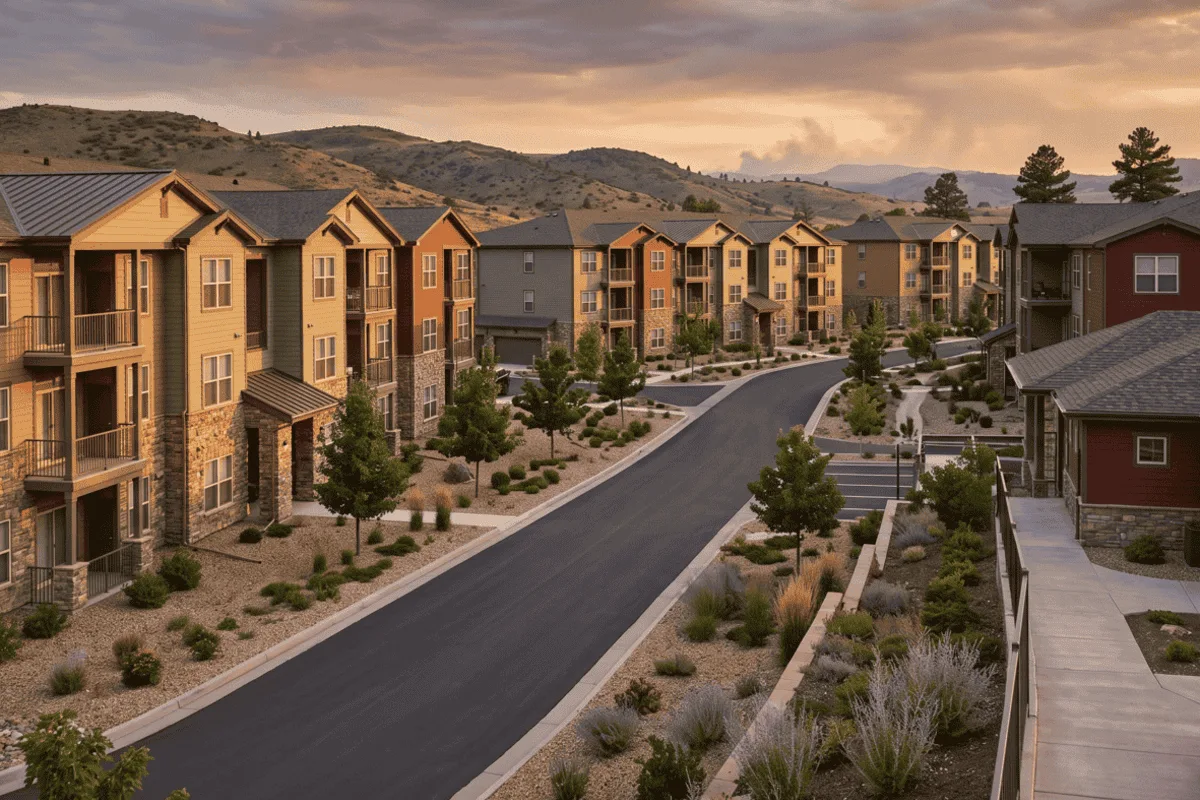
These projects affect shared spaces, residents, board approvals, budgets, and property-wide consistency, so an unclear scope creates confusion quickly. Exterior systems also connect: rooflines, gutters, siding, trim, windows, and decks all influence one another.
Code adds weight to that interconnection, and the timeline is no longer theoretical: jurisdictions adopted the code by April 2026 and began enforcement that July. A piecemeal upgrade can leave a community partially compliant and create mismatched materials or repeated disruption. Our fire-resilient home guide breaks down what the code covers.
Which Exterior Systems Does the Wildfire Code Touch?
Most exterior systems play a role in fire resistance, which is why boards benefit from reviewing them together rather than one at a time. Here is how the major systems fit a code-aware plan.
Siding and Trim
Siding is a primary code surface, and the code accepts noncombustible materials, fire-retardant-treated wood, or ignition-resistant assemblies: fiber cement, stucco, and concrete log all qualify for siding installation in WUI zones. Across multiple buildings, profile, color, and finish should stay consistent for both appearance and performance.
Trim transitions around windows, doors, decks, and rooflines also matter, because gaps there are both weather and ember entry points. Coordinating these details keeps the envelope tight, and color and trim decisions are easier when made property-wide. Handled together, siding and trim protect the building and the community’s curb appeal at once.
Roofing and Gutters
Roofing is one of the code’s biggest levers, and a Class A assembly paired with impact-resistant shingles on multi-family buildings addresses Colorado’s two top threats, fire and hail, at once. Specs like these are worth setting property-wide with a roofing contractor before the first building is scoped.
Debris in gutters and on roofs is a known ember catch, so drainage and maintenance access belong in the plan. For multi-building communities, consistent roofing specs also simplify long-term upkeep. A coordinated roof-and-gutter review keeps small issues from spreading across the property.
Windows and Decks
Windows can fail from radiant heat before flames arrive, so tempered glass and heat-stable frames are the code-smart upgrades in higher-intensity zones, which puts replacement windows on the scope list earlier than most boards expect.
Decks are attached, combustible, and ember-prone, so ignition-resistant boards, enclosed undersides, and clean clearances reduce risk. Boards unsure where their structures stand can start with deck wildfire risk, then coordinate deck replacement with ledgers, siding, and drainage to keep the work cohesive. Together, these upgrades close two of the envelope’s most vulnerable points.
How Should Boards Plan and Phase the Work?
Code-aware remodels add budget and documentation considerations on top of the usual logistics. Before approving a scope, boards and managers should plan around:
- Whether the community is in a WUI zone and which code requirements apply
- Product consistency, warranties, and compliant materials across all buildings
- Reserve funding and phasing for larger envelope upgrades
- Resident notices, parking, staging, and access organized by building
- Documentation of code-compliant work for insurance and resale
- A single communication point for boards, owners, and managers
Phasing keeps disruption and cost manageable while moving the whole community toward compliance, though replacing more than 25% of a roof covering can trigger full compliance on its own, which is worth knowing before a phase is scoped. A clear scope tells everyone what is included, what is not, and how the work will roll out across buildings.
How Should Communities Compare Exterior Remodeling Contractors?
Beyond price, communities should weigh multi-building experience, coordination across systems, clear scopes, and local code knowledge. Reviewing a contractor’s completed community projects shows whether they can deliver consistent work at scale.
For wildfire-code work specifically, ask whether the contractor can coordinate siding, roofing, windows, and decks to current standards, and whether they document compliance. Communication and follow-through shape the project experience as much as the materials themselves.
Why Choose GS Exterior Experts for HOA and Multi-Family Exterior Remodeling?
GS Exterior Experts helps HOAs, managers, and multi-family communities plan exterior projects with structure, communication, and code awareness. Family-owned and serving the Denver metro since 1999, we coordinate work spanning siding, roofing, windows, decks, and trim across multi-building properties.
- We help boards evaluate exterior scope and code exposure before a scope is approved.
- We coordinate siding, roofing, windows, decks, and related details as one envelope.
- We work at the community scale, with the owner involved throughout and a single point of contact for the board.
- We handle storm-damage insurance claims and document code-compliant work for reserves and resale.
- We’re BBB A+ rated and 5-star Google rated, with permits and warranties handled in writing.
A better project starts with a clear plan. Our team helps communities make informed decisions before work begins, so the remodel can move forward with fewer surprises.
Planning a Wildfire-Code Compliant Exterior Remodel for Your Community?
Wildfire-code exterior remodels work best when boards have a clear scope, consistent materials, and a phasing plan residents can follow. The right approach protects buildings, supports compliance, and helps with long-term maintenance planning.
Contact GS Exterior Experts to discuss your HOA or multi-family project. We can review your goals, evaluate your exterior systems against current code, and plan the next step for your Denver-area community.