

Most Colorado homes built before the 1990s have insulation between the studs and nothing over them. That leaves the framing itself as a thermal bridge, and on a typical wall, the studs account for roughly a quarter of the surface area.
A re-side is the one time that is straightforward to fix. The wall is open, the sheathing is exposed, and adding a layer of continuous insulation over the studs costs far less as part of a project you are already doing than it ever will as a standalone job. Here are some things you need to find out when choosing exterior insulation for a re-side.
What Is the R-Value?
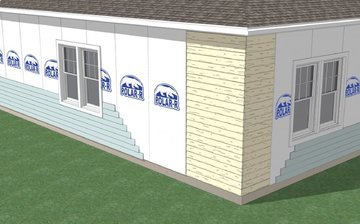
R-value measures how well a material resists heat flow. Higher is better, and it is stated per inch of thickness, so a product’s total R-value depends on how thick it is. For reference on a re-side: rigid foam runs roughly R-4 to R-6.5 per inch, depending on type, foil-faced polyiso being the highest. A half-inch fanfold underlayment adds about R-2 to R-3. Insulated vinyl siding adds around R-2 to R-3 as part of the panel. Most of Colorado sits in climate zone 5, where the current energy code calls for continuous exterior insulation on new walls. Adding it during a re-side brings an older home considerably closer to that standard.
The R stands for its resistance to heat flow. A high R-value is especially beneficial in winter, to keep the warm air inside your home and the cold air out. It also reduces heat flow in the opposite direction in the summer. So, when making comparisons, notice the R-value of each product you’re considering.
How Well Does the Insulation Retain Its R-Value?
R-value doesn’t necessarily stay constant over time. First of all, you’ll find different figures for colder weather and warmer weather. The R-value is higher at 75 degrees than it is at 40 degrees. You need to choose exterior insulation that will have an adequate R-value given the climate where your home is located. Since winters are cold in Colorado, anyone living there should have insulation with a high R-value at colder temperatures.
Some insulation loses R-value over time. Closed-cell polyiso is the main example, because the blowing agent that gives it a high initial R-value slowly diffuses out, a process called thermal drift. Expanded polystyrene, which is what products like ACH Foam-Control R-SHIELD underlayment use, does not drift and holds its rated value. That matters more in Colorado than in milder climates, because polyiso also performs worse as temperature drops, which is precisely when you need it.
Thinking About Cost
Adding exterior insulation during a re-side is far cheaper than doing it separately, because the labor to remove and replace siding is already in the project. The material is the main added cost, and the thickness you choose affects trim and window detailing, since the wall gets thicker. That last point is worth raising early. Going beyond about an inch of foam usually means extending window and door jambs, which adds labor.
You Might Not Need to Remove the Old
Thin fanfold underlayment can sometimes go over existing siding, which is cheaper. We usually recommend against it, for the same reason we recommend against siding over siding generally: it hides whatever is underneath, and rotten sheathing or failed flashing does not stop being a problem because there is foam over it. Full removal lets us inspect the wall, correct the water-resistive barrier, and install insulation properly over clean sheathing.

Be sure to Figure in Long-Term Energy Savings
Continuous exterior insulation does reduce heating costs, and how much it depends on what your walls have now, how exposed the house is, and how you heat it. A home with uninsulated cavities sees a far bigger change than one already at code. What we can say without qualification is that the marginal cost of adding it during a re-side is low, because the expensive part of the job is happening anyway. Whether it pays back in four years or twelve, it is the cheapest it will ever be to do.
Final Words
If you are already planning a re-side, this is worth deciding on before the quote is finalized, rather than after, because it affects trim, window details, and material ordering.
Call us at (720) 683-6288 or contact us, and we will price the wall with and without it so you can see the difference. Serving Colorado homeowners since 1999.